|
|
 |
|
New! Find Great Prices on...
|
|  
|
|
 
|
|
 |
The
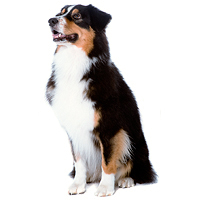
Breed at a Glance
|
 |
|
|
|
Recognized by
|
AKC, CanKC, CKC, UKC, KCUK, FCI |
|
Country of Origin
|
United States |
|
Life Expectancy
|
13 - 15 yrs |
|
Height Range
|
20 - 23 in (M); 18 - 21 in (F) |
|
Weight
Range
|
50 - 65 lbs (M); 40 - 55 lbs (F) |
|
Colors
|
Red, Red Merle, Blue Merle, Black; with or without white markings, with or without tan/copper points
|
|
|
|
|

|
|
|
|
|
|
Trainability
|
Excellent. Natural for obedience.
|
|
With Children
|
Very good
|
|
With Animals
|
Good
|
|
Climate
|
Tolerates cold well
|
|
Indoor / Outdoor
|
Enjoys indoor compaionship but needs lots of outdoor room
|
|
Exercise Reqd
|
High. Needs plenty of outdoor exercise and interaction
|
|
Grooming Reqd
|
Moderate, due to dense coat
|
|
|
|
|
|
|
|
 |
Australian Shepherd Information
|
 |
|
|
IMPORTANT: The American Kennel Club (AKC) does not recognize any size varieties of the Australian Shepherd. Descriptive words like "toy" or "miniature" are likely to indicate sizes that are below AKC breed standard. There is a concern among many reputable breeders that breeding down may be done without adequate concern for health. Since breeding for smaller size can result in significant health issues, it is important to research thoroughly any off-standard size and make sure that all appropriate health screenings are performed on adults and puppies. The founding registry for the breed is the Australian Shepherd Club of America. This organization is responsible for the development of the breed and breed standard, and they maintain their own registry and shows. The ASCA maintains a stringent code of ethics among members, so many respected, reputable breeders will dual-register with both ASCA and AKC.  |
|
|
|
|
|
|
 |
Health Information
|
 |
|
|
Congenital and Genetic Conditions found with greater than average frequency in the Australian Shepherd (point to name for description):
Following are health screenings often performed on breeding Australian Shepherd adults; choosing a puppy from a breeder who tests parents for health can help avoid future health problems in your puppy:
Cardiac Evaluation - OFA
Collie Eye Anomaly (genetic test)
CERF Screening (Canine Eye Research Foundation)
Hip Dysplasia (OFA or PennHIP)
Multiple Drug Resistance Gene (MDR1, genetic test)
This is presented solely as a starting point for you to learn and ask questions about the breed. This information is NOT to be used to diagnose, evaluate, or treat any condition whatsoever. For specific information, consult your veterinarian. The above diseases and conditions are found with a higher-than-average frequency in the Australian Shepherd. These conditions may or may not be severe, and may or may not be hereditary. Some conditions may actually be "normal" for the breed, such as alopecia in the hairless breeds; some may be intrinsic to the breed due to its physiology, such as skin fold dermatitis in the Pug, Bulldog, and Shar-Pei; some may be related to care and nutrition; and some may be strictly genetic.
The best source of additional and more detailed information on these conditions is a veterinarian, breed club, or knowledgeable breeder.
|
|
|
 |
  |
 |
|
|
|
 |
Australian Shepherd Links
|
 |
|
|
Available Books (click to order)
|
|
|
|
|
|
|
| Support our site by supporting this advertiser
|
|
|
|
 |
 |
|