|
|
 |
|
New! Find Great Prices on...
|
|  
|
|
 
|
|
 |
The
Breed at a Glance
|
 |
|
|
|
Recognized by
|
AKC |
|
Country of Origin
|
Great Britain |
|
Life Expectancy
|
7 - 9 yrs |
|
Height Range
|
22 - 24.5 in |
|
Weight
Range
|
55 - 70 lbs |
|
Colors
|
Solid black or liver
|
|
|
|
|

|
|
|
|
|
|
Trainability
|
Highly trainable although easily bored. Training sessions should be kept short and fun and with a light hand
|
|
With Children
|
Flat-Coated Retrievers are excellent with children, although no dog should be left unattended with children
|
|
With Animals
|
They do well with a variety of other pets
|
|
Climate
|
Tolerates moderate heat and cold well
|
|
Indoor / Outdoor
|
They do best living indoors with their family and playing outdoors
|
|
Exercise Reqd
|
High. Flat-Coated Retrievers require ample exercise with some burn off to be at their best behavior.
|
|
Grooming Reqd
|
Brushing as needed and trimming of the feathering on ears and legs
|
|
|
|
|
|
|
|
 |
Flat-Coated Retriever Information
|
 |
|
|
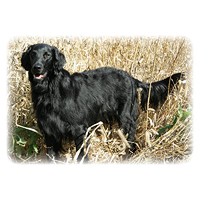
The Flat-Coated Retriever was developed in Great Britain in the late 1800's with the advent of the breachcock shotgun requiring a need for a faster retriever. Dogs used in developement were Setters, Spaniels, Collie, St. John's Water Dog, and Wavy Coated Retriever. The Flat-Coated Retriever was deveoped from the start to be a dual-purpose breed as both a working retriever and show dog. The Flat-Coated Retriever is a medium sized active dog that shows power without lumber and raciness without weediness. They are natural retrievers and make an excellent family companion hunting retriever for upland game as well as waterfowl. (They love water.) Flat-Coated Retrievers are slow to mature and often carry on their enthusiam for life (exhibited by a constant wagging tail) and playfullness into their late years. Flat-Coated Retrievers should be trained early with a "light" hand and consistency. They are eager to please but do not respond well to harsh punishment. If left un-trained and un-attended the Flat-Coat could develope into a destructive dog. Being a retriever they like to carry things in their mouths and need plenty of toys to chew. The Flat-Coated Retriever is a family/companion working retriever that is at it's best with family interaction and a job to do. With the proper traing and family interaction the Flat-Coated Retriever will make an excellent addition to the family. Information courtesy of flat-coat.com  |
|
|
|
|
|
|
 |
Health Information
|
 |
|
|
Congenital and Genetic Conditions found with greater than average frequency in the Flat-Coated Retriever (point to name for description):
Following are health screenings often performed on breeding Flat-Coated Retriever adults; choosing a puppy from a breeder who tests parents for health can help avoid future health problems in your puppy:
CERF Screening (Canine Eye Research Foundation)
Hip Dysplasia (OFA or PennHIP)
Patellar Luxation Test - OFA
This is presented solely as a starting point for you to learn and ask questions about the breed. This information is NOT to be used to diagnose, evaluate, or treat any condition whatsoever. For specific information, consult your veterinarian. The above diseases and conditions are found with a higher-than-average frequency in the Flat-Coated Retriever. These conditions may or may not be severe, and may or may not be hereditary. Some conditions may actually be "normal" for the breed, such as alopecia in the hairless breeds; some may be intrinsic to the breed due to its physiology, such as skin fold dermatitis in the Pug, Bulldog, and Shar-Pei; some may be related to care and nutrition; and some may be strictly genetic.
The best source of additional and more detailed information on these conditions is a veterinarian, breed club, or knowledgeable breeder.
|
|
|
 |
  |
 |
|
|
|
 |
Flat-Coated Retriever Links
|
 |
|
|
Available Books (click to order)
|
|
|
|
|
|
|
| Support our site by supporting this advertiser
|
|
|
|
|
 |
 |
|