|
|
 |
|
New! Find Great Prices on...
|
|  
|
|
 
|
|
 |
The
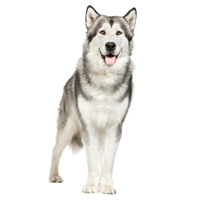
Breed at a Glance
|
 |
|
|
|
Recognized by
|
AKC, CanKC, CKC, UKC, KCUK, FCI |
|
Country of Origin
|
United States |
|
Life Expectancy
|
12 - 14 yrs |
|
Height Range
|
23 - 28 in |
|
Weight
Range
|
85 - 125 lbs |
|
Colors
|
Grey (light through dark) or red (gold through liver), white underbody, legs, feet, and mask
|
|
|
|
|

|
|
|
|
|
|
Trainability
|
Intelligent, but effort is required in training
|
|
With Children
|
Good. Supervise with infants and toddlers.
|
|
With Animals
|
Can be aggressive with other animals
|
|
Climate
|
Excellent in cold climates
|
|
Indoor / Outdoor
|
Needs plenty of room outdoors.
|
|
Exercise Reqd
|
High. Needs plenty of exercise daily.
|
|
Grooming Reqd
|
Requires brushing fairly often
|
|
|
|
|
|
|
|
 |
Alaskan Malamute Information
|
 |
|
|
Also, Chondrodysplasia (ChD) by X-Ray, certified by AMCA
  |
|
|
|
|
|
|
 |
Health Information
|
 |
|
|
Congenital and Genetic Conditions found with greater than average frequency in the Alaskan Malamute (point to name for description):
Following are health screenings often performed on breeding Alaskan Malamute adults; choosing a puppy from a breeder who tests parents for health can help avoid future health problems in your puppy:
CERF Screening (Canine Eye Research Foundation)
Hip Dysplasia (OFA or PennHIP)
Thyroid Function Test (blood test)
This is presented solely as a starting point for you to learn and ask questions about the breed. This information is NOT to be used to diagnose, evaluate, or treat any condition whatsoever. For specific information, consult your veterinarian. The above diseases and conditions are found with a higher-than-average frequency in the Alaskan Malamute. These conditions may or may not be severe, and may or may not be hereditary. Some conditions may actually be "normal" for the breed, such as alopecia in the hairless breeds; some may be intrinsic to the breed due to its physiology, such as skin fold dermatitis in the Pug, Bulldog, and Shar-Pei; some may be related to care and nutrition; and some may be strictly genetic.
The best source of additional and more detailed information on these conditions is a veterinarian, breed club, or knowledgeable breeder.
|
|
|
 |
  |
 |
|
|
|
 |
Alaskan Malamute Links
|
 |
|
|
Available Books (click to order)
|
|
|
|
|
|
|
| Support our site by supporting this advertiser
|
|
|
|
|
 |
 |
|